 blog
5 Family Fly Fishing Trips That Actually Work for Beginners
Last Updated: October 25, 2026
Quick Summary
Family fly fishing trips offer structured learning and real catches with a professional guide who removes the anxiety of wasting money or boring kids. A guide diagnoses casting problems in minutes and builds confidence in real time, making these trips ideal for beginners of all ages.
- Half-day trips of four to six hours work best for families with children under 12 or first-timers.
- Ask guides about water type, included gear, species expectations, and cancellation policies before booking.
- Bring proper layers, waterproof gear, wading boots, and snacks; confirm children's wader sizes in advance.
- Most guides price by trip rather than per person, so families of four often pay less per angler than solo travelers.
- Match trip length and water type to each child's attention span, not just age.
Table of Contents
- Why Guided Family Fly Fishing Trips Work for All Skill Levels
- Half-Day Fly Fishing Trips: The Right Length for Families
- Questions to Ask a Fishing Guide Before You Book
- What to Bring on a Fly Fishing Trip: The Family Checklist
- Understanding Guided Fly Fishing Trip Cost and What's Included
- Matching Your Family's Age and Experience to the Right Trip
- Booking Your Family's First Guided Fly Fishing Adventure
- Frequently Asked Questions
Why Guided Family Fly Fishing Trips Work for All Skill Levels
Family fly fishing trips offer something most outdoor activities don't: a structured way to learn together while actually catching fish.
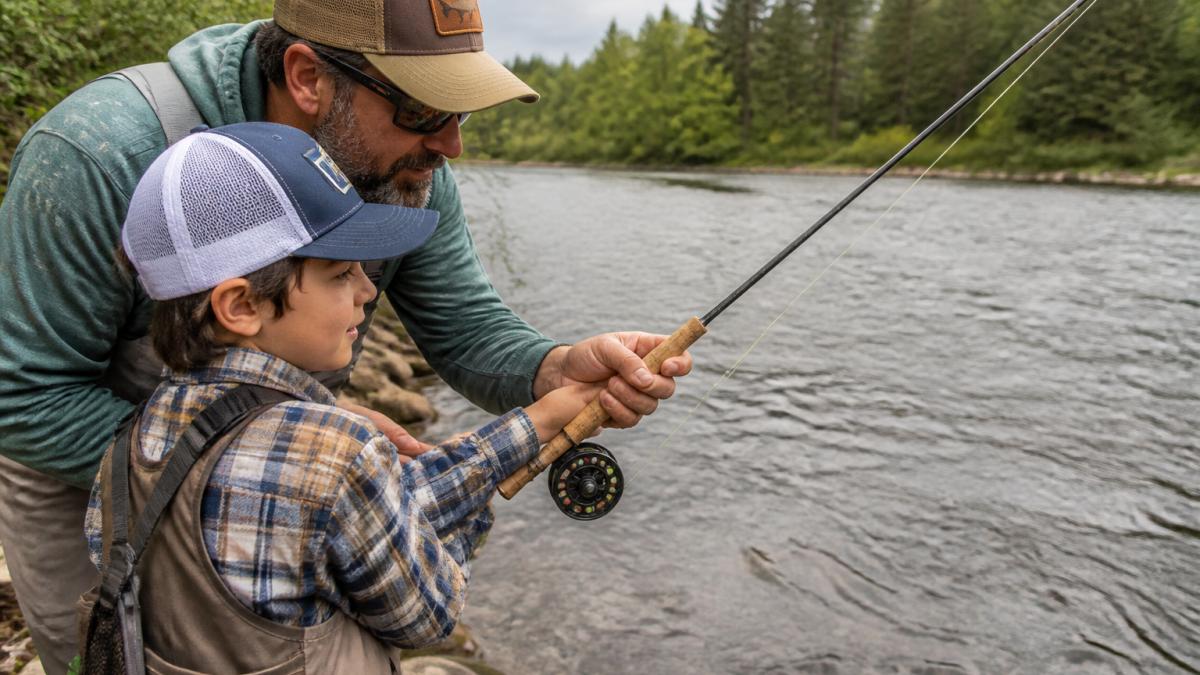
A professional guide knows where the fish are, understands water conditions, and can diagnose a bad cast within five minutes. That matters for families: parents worry about wasting money or boring their kids, and kids worry they'll fail. A guide removes both anxieties by building confidence in real time.
At Smith River Outfitter Raleigh Fly Fishing, we provide expert-led fly fishing experiences tailored to enthusiasts of all skill levels.
This guide covers the five types of family fly fishing trips that work for beginners, what to expect before you book, and how to prepare.
Half-Day Fly Fishing Trips: The Right Length for Families
Half-day fly fishing trips are the sweet spot for families new to the sport.
The rhythm: your guide meets you, reviews safety and basic casting, then moves to the water.
Half-day trips work best for families with children under 12 or first-timers. Check out local fly fishing guide service costs and pricing to budget your family's trip.
The trade-off is obvious: you see less water and catch fewer fish than a full-day trip.
Questions to Ask a Fishing Guide Before You Book
Asking the right questions before booking separates a great experience from a disappointing one. Learn what to expect on a guided fly fishing trip so you can prepare your family with confidence.
Ask about the water: river or lake, distance from the meeting point, and terrain, easy wading or challenging.
Clarify what's included: rods and reels, flies, leaders, and small gear. Can the guide accommodate left-handed casters?
Ask about species and realistic expectations, what you're likely to catch, what size, how many.
Finally, ask about cancellation and weather policies: what happens if it rains, can you reschedule for free, and what if conditions are unsafe?
U.S. Geological Survey guidance on freshwater fishing safety
What to Bring on a Fly Fishing Trip: The Family Checklist
Packing for a fly fishing trip isn't complicated, but forgetting essentials ruins the day. Here's what families need:
Clothing and Protection:
- Layers appropriate for the season (water is colder than air)
- Waterproof jacket and pants
- Hat with a brim to shield from sun and rain
Footwear:
- Wading boots or water shoes with good grip
- Avoid regular sneakers, they're slippery on rocks and drain poorly
- Bring an extra pair of socks
Personal Items:
- Snacks and water (your guide may provide some, but bring your own)
- Insect repellent (mosquitoes are real)
- Any medications your family needs
Optional but Valuable:
- Dry bag for valuables and extra clothes
- Camera or GoPro to capture memories
- Fishing net (though guides usually have extras)
Ask your guide what's provided. Learn more about what gear guides provide versus what families need to bring before packing.
One common mistake: assuming kids' regular clothes will work. They won't. Water temperatures drop quickly, and wet regular clothes cause hypothermia faster than you'd expect. Proper layers and waterproof gear are essential.
National Park Service recommendations for water safety and outdoor preparation
Understanding Guided Fly Fishing Trip Cost and What's Included
Guided fly fishing trip pricing is not one number, and families who understand the structure make better decisions than those who only ask "How much?" Most full-service outfitters price by the trip, not the person, so a family of four often pays far less per angler than a solo traveler.
Use this framework when requesting quotes from two or three outfitters.
The four pricing variables that matter most:
- Trip length. A half-day (typically 4 hours) usually runs roughly 60 to 70 percent of a full-day (8 hours) rate at the same outfitter. The per-hour cost is higher on a half-day, but the total commitment is lower, which is why half-days are the standard entry point for families with younger children.
- Group size. Most guides quote a base rate that covers one or two anglers, then add a per-person charge for each additional angler. A family of four commonly pays a base rate plus two add-on fees. Ask specifically: "Is your rate all-in for four, or is there a per-person charge above two?"
- Water access and travel. Walk-and-wade trips on public water are typically the least expensive format. Float trips that require a drift boat, shuttle, or private access carry a higher rate because of equipment and logistics. Ask whether transportation to the put-in is included or billed separately.
What a typical family quote should itemize:
| Line item | Usually included | Often extra |
|---|---|---|
| Guide time and instruction | Yes | , |
| Rods, reels, flies, leaders | Yes (confirm) | Sometimes a gear fee |
| Waders and boots | Often, in adult sizes | Kids' sizes frequently not stocked |
| Drift boat or shuttle | On float trips | On some wade trips |
| Lunch and drinks | Full-day trips, sometimes | Half-day trips, usually not |
| Fishing license | Rarely | Almost always the family's responsibility |
| Gratuity | No | Customary, typically 15-20% of trip cost |
That last row surprises many families. Guide gratuity is standard for guided outdoor services and is not included in the quoted rate.
The value question, answered concretely. A guide compresses the learning curve: casting, reading water, fly selection, and hook-set timing are corrected in real time instead of through trial and error. For a family, the return is fewer frustrated kids, less time untangling lines on unproductive water, and a higher chance the first outing becomes a repeat outing.
Budget-saving moves that do not sacrifice the experience:
- Book a weekday half-day in shoulder season rather than a peak Saturday full-day.
- Ask whether the outfitter offers a family or multi-child rate, many do but do not advertise it.
- Bring your own polarized sunglasses, hats, and rain layers so you are not renting or buying them at the last minute.
State fish and wildlife agency license and regulation lookup
Once you have two or three itemized quotes in the same format, the decision usually becomes obvious.
Matching Your Family's Age and Experience to the Right Trip
Age alone does not determine the right trip, attention span, prior experience, and what your family wants from the day matter just as much.
Step 1: Score attention span, not just age.
Ask yourself how long each child stays engaged in a hands-on outdoor activity before needing a break. A useful rule of thumb:
- Under 90 minutes of focus: half-day trip, calm easy-access water, plan on frequent snack and shade breaks.
- 90 minutes to 3 hours: half-day or a full day with a midday break; these kids can handle real instruction.
- 3 hours or more: full-day trips become realistic, including float trips and more challenging wading.
Step 2: Match the fishing method to the child.
Fly fishing and spin fishing are different tools, and the right choice depends on age and temperament.
- Fly fishing rewards patience and timing. It is the more technical method, and it is what most guided fly trips teach. It suits kids roughly 10 and older who enjoy learning a skill and can tolerate a few missed hook-sets.
- Spin fishing is simpler to operate and often produces faster action for younger or less patient anglers. Many family-oriented guides keep spin rods on the boat as a backup so a frustrated 7-year-old can switch and stay engaged.
Step 3: Match the water to mobility and comfort.
- Walk-and-wade on gentle riffles: best for ages 8 and up and for adults with moderate mobility. Ask about bank steepness and whether the walk is under 10 minutes.
- Float trips (drift boat or raft): best for ages 10 and up and for families who want to cover water without hiking. Confirm life jacket sizes for children and whether the boat has a casting deck safe for kids.
- Stillwater and pond trips: the most accessible option, good for young children and anyone with limited mobility. Ask whether the guide has a boat with stable seating and shade.
Step 4: Ask the accessibility and safety questions competitors rarely answer.
- Are U.S. Coast Guard-approved life jackets available in your children's sizes, or should you bring your own?
- Are there restrooms at the meeting point or along the route?
- What is the plan if weather turns, is there a sheltered spot, and does the guide reschedule?
Step 5: Set realistic catch expectations by season and species.
Ask what is actually in season and catchable during your dates.
Quick decision matrix:
| Family profile | Best trip | Method | Key question to ask |
|---|---|---|---|
| Kids 5-8, first time | Half-day, stillwater or gentle wade | Spin fallback | Are child life jackets and spin rods available? |
| Kids 9-12, curious | Half-day or full day, wade | Fly with spin backup | How much one-on-one instruction per child? |
| Teens, interested | Full day, float or wade | Fly | Can we target a specific species? |
| Mixed ages | Half-day, easy access | Both | Can you pace the day around the youngest? |
| Limited mobility | Stillwater or boat | Either | Is the boat stable and shaded? |
Run through these five steps with your guide before you book. Ten minutes of matching prevents the most common family disappointment: a trip that was right for the adults and wrong for the kids.
Booking Your Family's First Guided Fly Fishing Adventure
Booking a guided trip involves a few straightforward steps. Then review how to book a fly fishing guide step by step.
Contact your guide with specifics: ages, experience level, and what you hope to accomplish.
Confirm what's included and what to bring, plus cancellation policies, weather contingencies, and meeting logistics, pickup times, parking, and arrival expectations.
Finalize payment and any required paperwork. Most outfitters ask for a deposit to hold your date.
Show up early on the day of your trip, bring everything on your checklist, and listen to your guide's safety briefing.
Frequently Asked Questions
What age can children start on guided fly fishing trips?
Most family fly fishing trips accept children ages 6 and up, though readiness depends on attention span and physical coordination more than age alone. Younger children (6-8) do best on shorter trips with frequent breaks. A fishing guide can assess your child's readiness during a pre-trip conversation and suggest the right trip duration and location. Always confirm age requirements and adult supervision policies when booking.
How long should a half-day fly fishing trip last for families?
A half-day fly fishing trip typically runs 4-6 hours, which balances instruction time with children's stamina. This length gives beginners time to practice casting, learn basic technique, and experience actual fishing without overwhelming younger anglers. Most families find a four-hour outing ideal for first-timers; experienced kids may enjoy the full six hours. Ask your guide what duration suits your family's experience level.
What questions should I ask a fishing guide before booking?
Ask about the guide's experience with children, what fishing technique you'll use (fly casting, spin fishing, or both), whether gear is provided, what fish species you'll target, the exact trip duration, what's included (meals, transportation, boat access), cancellation and weather policies, and whether the guide offers instruction or focuses on catching fish. These questions help you confirm the trip matches your family's expectations and comfort level.
Do I need to buy fly fishing gear before a guided trip?
No. Most guided fly fishing trips include all necessary equipment: rods, reels, line, waders, and flies. Bringing your own gear is optional and only necessary if you already own equipment you prefer. Ask your guide what's provided when you book. This removes the financial barrier for families testing whether fly fishing is right for them before investing in personal gear.
Your family's first guided fly fishing adventure starts with choosing the right trip and guide. Smith River Outfitter Raleigh Fly Fishing specializes in designing family fly fishing trips tailored to your skill level, with patient instruction, access to productive local water, and the deep knowledge of conditions that turns a good day into a memorable one. Get started with Smith River Outfitter Raleigh Fly Fishing and discover why families keep coming back.