 blog
What Is the Best Fly Rod for Small Streams?
Last Updated: October 30, 2026
Quick Summary
The best fly rod for small streams is a short, light rod, typically 6 to 7 feet 6 inches in a 3-weight or 4-weight, because tight water rewards accuracy over distance. A 3-weight suits brook trout and dry flies, while a 4-weight handles dry-dropper rigs and bigger fish. Medium to medium-fast action gives the best casting accuracy at short distances.
- Below about 6 feet, line control and mending suffer, so 7 feet is the sweet spot for most wild trout water.
- Fiberglass rods load easily at short range and shrug off knocks, but graphite is lighter and more sensitive.
- Match the line weight to the rod exactly; over-lining a short rod collapses the loop and kills presentation.
- Build leaders around 7.5 to 9 feet for dries and 6 to 7.5 feet for dry-dropper work.
- A lightweight click-and-pawl reel balances a short rod; balance matters more than drag on small water.
Table of Contents
- Why Small Streams Demand a Different Fly Rod
- Fly Rod Length for Small Streams: Short Rods Win Tight Water
- The Best Fly Rod Weight for Small Streams: 3-Weight vs 4-Weight
- Fiberglass Fly Rods for Small Streams: Feel, Durability, and Trade-Offs
- Rod Action and Casting Accuracy at Short Distances
- Building a Small Stream Fly Rod and Reel Outfit
- Rod Picks by Angler Experience and Budget
- Trade-Offs of Short Rods in Open Water
- Frequently Asked Questions
Why Small Streams Demand a Different Fly Rod
The best fly rod for small streams is a short, light rod, typically 6 to 7 feet 6 inches in a 3-weight or 4-weight, because tight water rewards accuracy over distance. A standard 9-foot 5-weight that shines on big rivers becomes a liability on a creek the width of a driveway. A rod built for open water dragged into a tunnel of rhododendron and hemlock is one of the most common mistakes anglers make on tight water.
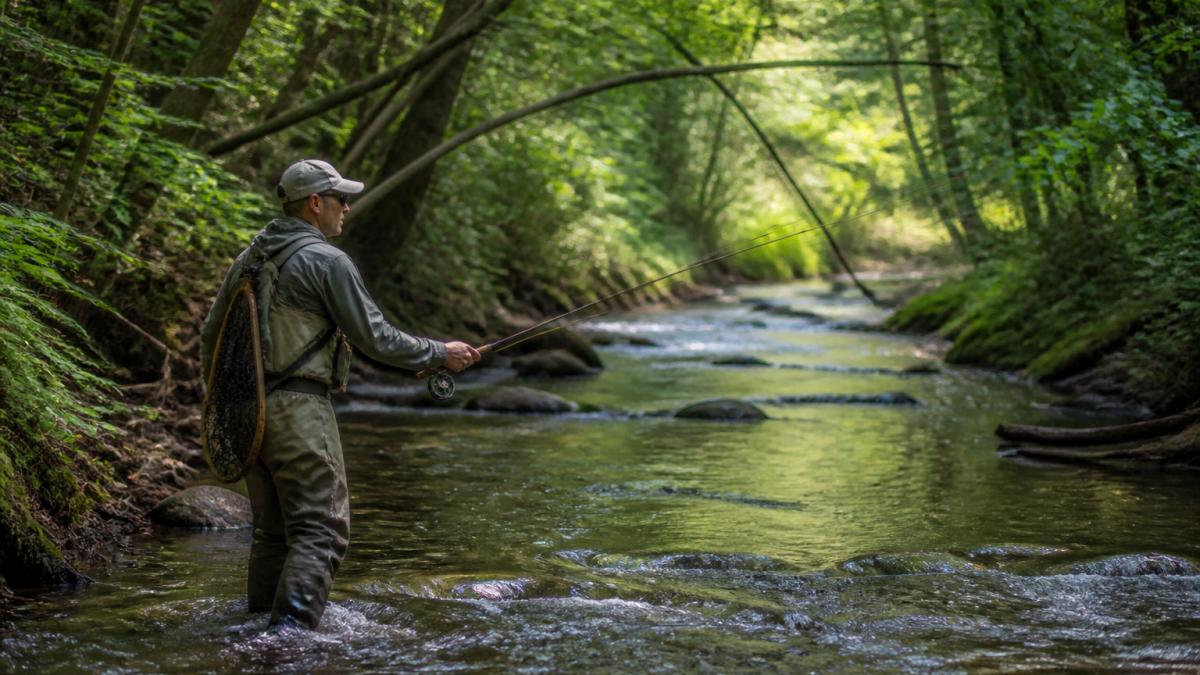
Small streams are a different sport. You get one backcast window, maybe two, and the fly needs to land within inches of a seam. Overhanging vegetation eats a long rod tip.
If you are still building your overall rod-selection framework before narrowing to stream-specific picks, our guide on how to choose a fly rod walks through length, weight, and action from the ground up.
Fly Rod Length for Small Streams: Short Rods Win Tight Water
Short rods win tight water because they keep the tip clear of branches and let you load the rod with a flick instead of a full casting stroke. On small creeks and confined spaces, a 6-foot rod, 6.5-foot rod, or 7-foot rod covers most situations. Step up to a 7-foot-6-inch rod when the stream opens slightly but still demands tight casting lanes.
How Short Is Too Short?
Below about 6 feet, line control and mending suffer. A very short rod struggles to hold line off the water and reach across conflicting currents. For most wild trout water, 7 feet is the sweet spot: short enough to dodge vegetation, long enough to mend.
The Best Fly Rod Weight for Small Streams: 3-Weight vs 4-Weight
A 3-weight is the best fly rod weight for small streams where brook trout and modest wild trout are the target and dry flies dominate.
Most rankings stop there and leave you to guess. The useful question is not which weight is "best" in the abstract but which weight fits the water in front of you. Use the four conditions below as a decision framework; they are the variables that actually change the answer.
A Decision Framework for Rod Weight
Work through these in order. The first condition that clearly applies usually settles the choice.
- Stream width and casting lane. Under roughly 10 feet of fishable width with a tunnel of canopy, a 3-weight's lighter line loads with less line out and lands softer. Once you have 15 to 20 feet of open lane and need to reach the far seam, the 4-weight carries line and turns over a longer leader with less effort.
- Fly size and rig type. Size 14 to 20 dries and small soft hackles are 3-weight territory. Add a dropper, a beadhead nymph, or a small indicator and the extra mass favors a 4-weight, which delivers the rig without collapsing the loop. Streamers above about size 8 push you to a 4-weight or heavier.
- Expected fish size. Brook trout and small wild rainbows in the 6- to 10-inch class are fine on a 3-weight. Water that regularly holds 12- to 16-inch fish, or fish with a log or undercut bank nearby, rewards the 4-weight's extra backbone to turn a fish before it reaches cover.
- Wind and exposure. An open meadow creek with a steady afternoon breeze is a 4-weight day. A 3-weight in wind forces a harder stroke and costs accuracy.
When a 2-Weight or 5-Weight Makes Sense
A 2-weight suits tiny flies and calm, technical water, but it limits you in wind and with heavier rigs. It is a specialist tool for glassy pools and spooky fish, not a general small-stream rod.
A 5-weight makes sense on small water that holds bigger fish or sees streamer fishing, where you need more backbone to turn a fish away from a log.
Weight and Rod Length Interact
Weight and length are not independent choices. A 6-foot 3-weight and a 7-foot-6-inch 3-weight cast very differently: the longer rod gives more line control and mending leverage, while the shorter rod clears canopy. If you are leaning 3-weight for delicacy but fishing water that occasionally opens up, a 7-foot-6-inch 3-weight is often a better answer than a 6-foot 4-weight. Decide length from the canopy and weight from the fly and fish, then check that the combination still balances in your hand.
A Quick Weight-Selection Checklist
- Tight canopy, dries only, small fish: 3-weight.
- Tight canopy, dry-dropper, mixed fish: 4-weight.
- Glassy technical pool, tiny flies, calm: 2-weight.
If you are still building your overall rod-selection framework before narrowing to stream-specific picks, our guide on how to choose a fly rod walks through length, weight, and action from the ground up.
Fiberglass Fly Rods for Small Streams: Feel, Durability, and Trade-Offs
Fiberglass fly rods for small streams deliver a slow, forgiving feel that loads easily at short range, which is exactly what tight-creek casting demands. The material is durable and shrugs off the knocks that come with brushy banks. The trade-off is weight and a softer tip that can feel vague in wind.
Graphite vs Fiberglass on a Tight Creek
Graphite is lighter and more sensitive, transmitting a fish's take and helping with precision casting. Fiberglass is more relaxed and forgiving of a rushed stroke. For a beginner, fiberglass smooths out timing errors. For an experienced angler chasing sensitivity, graphite wins.
Rod Action and Casting Accuracy at Short Distances
Medium to medium-fast action gives the best casting accuracy at short distances on small streams.
Accuracy at short range comes down to fundamentals, not gear. Our beginner's guide to casting a fly rod walks through the fundamentals step by step.
Watch out: over-lining a short rod with too heavy a fly line is a common mistake. It overloads the rod on short casts and kills the delicate presentation small-stream trout require.
Building a Small Stream Fly Rod and Reel Outfit
A small stream fly rod and reel outfit should stay light and simple: a short 3- or 4-weight rod, a lightweight reel that balances it, a weight-forward or double-taper line matched to the rod, and a leader tapered down to a fine tippet.
The gap in most buying guides is the matching logic. A rod is only as good as the line, leader, and tippet hanging off it, and small-stream setups are less forgiving of mismatches than big-river rigs because every cast is short and every presentation is close.
Matching the Fly Line to the Rod
Match the line weight to the rod exactly; do not over-line a short rod to "help it load." A 3-weight rod wants a 3-weight line.
- Weight-forward (WF) line puts more mass in the front taper, which helps turn over a leader and a small dry at 15 to 25 feet. It is the more versatile choice if you also throw the occasional dropper or small streamer.
- Double-taper (DT) line gives a delicate presentation and lets you reverse the line when one end wears, which stretches its life. It suits anglers who fish dries almost exclusively and want the softest landing.
A common pattern is to run a WF line on a 4-weight for versatility and a DT line on a 3-weight for dry-fly delicacy. Either works; the point is to match the taper to how you actually fish.
Building the Leader and Tippet
Build a leader around 7.5 to 9 feet for dry flies and shorter, roughly 6 to 7.5 feet, for dry-dropper work. A shorter leader turns over a heavier rig more easily in tight quarters; a longer leader buys drag-free drift on flat, clear pools.
Tippet in the 5X to 6X range covers most small-stream trout and small fly sizes. As a rule of thumb, match tippet to fly size: 5X for size 12 to 16 flies, 6X for size 16 to 20.
Balancing the Reel
A lightweight click-and-pawl reel is the right call. It balances a short, light rod, holds enough line for the short casts small streams demand, and adds little weight. Balance matters more than drag: the reel should sit on the rod so the outfit feels neutral in your hand, not tip-heavy. On small water you rarely need a disc drag, so spend the money on the rod and line instead.
A Component-by-Component Setup
| Outfit Component | Small Stream Pick | Why It Fits |
|---|---|---|
| Rod | 7-foot 3- or 4-weight | Clears brush, loads at short range |
| Rod material | Fiberglass or medium graphite | Forgiving feel, good sensitivity |
| Reel | Lightweight click-and-pawl | Balances rod, simple and light |
| Fly line | WF for versatility, DT for dry-fly delicacy | Matched to rod weight, turns over short casts |
| Leader | 7.5-9 feet for dries, 6-7.5 feet for dry-dropper | Turns over small flies, fights drag |
| Tippet | 5X for size 12-16, 6X for size 16-20 | Matches small flies and spooky trout |
Putting It Together
Rig the rod, then check three things before you leave the truck: the line weight matches the rod, the leader length suits the canopy you will fish, and the tippet matches the fly you plan to tie on. Reliable knots hold the whole system together. Our guide to fly fishing knots every angler needs covers the knots for tying line to leader and tippet. Get those three right and a modest outfit fishes as well as an expensive one on water where long casts never happen.
Rod Picks by Angler Experience and Budget
Experienced anglers often prefer a sensitive graphite 3-weight for precise dry-fly work. Budget matters less than matching the rod to the water, but a modest outfit fishes fine on small creeks where long casts never happen.
Where you fish shapes the gear as much as your budget does. Our step-by-step guide to finding trout in rivers shows where trout actually hold in the streams you'll fish.
Trade-Offs of Short Rods in Open Water
Short rods fall short in open water. They cannot reach across a wide tailout, mend line over long distances, or fight a big fish with the use a longer rod provides.
Anglers weighing where a short rod stops working should consider both tight creeks and the open water where a longer rod earns its keep. Our fly fishing for trout in NC guide covers both tight creeks and open water.
Frequently Asked Questions
What length fly rod is best for small streams?
Most small-stream anglers land on a 7-foot or 7-foot-6-inch rod. That length gives you enough reach to mend line and keep a dry fly drag-free, while staying short enough to cast under overhanging vegetation and through tight casting lanes. A 6-foot or 6.5-foot rod shines on the most confined creeks, but you give up line control and reach. An 8-foot rod works when the stream opens up but feels clumsy in a tunnel of alders.
What weight fly rod should I use for small-stream trout?
A 3-weight or 4-weight covers most small-stream trout fishing. The 3-weight delivers small dry flies and dry-dropper rigs softly, which matters on clear, shallow water where wild brook trout and browns spook easily. The 4-weight adds a little backbone for wind, slightly larger flies, or the occasional 14-inch fish. Go lighter only if you fish tiny dries almost exclusively, and heavier if streamer fishing or bigger water is part of your day.
Are fiberglass fly rods good for small streams?
Yes. Fiberglass fly rods for small streams load easily at short distances, which suits the 15- to 30-foot casts these creeks demand. The slower action also protects light tippets and gives you a soft presentation. The trade-offs are weight and a slower recovery that costs you accuracy in wind. Graphite is lighter and crisper for precise casting, while fiberglass wins on feel and durability when you are banging a rod through brush.
How do you cast a fly rod in tight, overgrown streams?
Keep casts short and use a roll cast or a bow-and-arrow cast when trees leave no backcast room. Position yourself close to the target, aim for pockets and seams rather than long drifts, and let the current do the work. A short rod of 7 feet or less makes these casts easier because the tip clears vegetation. Practice sidearm casts too, since a low rod angle slips under branches that block a standard overhead cast.
Small-stream fishing rewards the right rod and a clean short cast, and both are easier to learn with a guide on the water. Smith River Outfitter Raleigh Fly Fishing offers expert-led trips for every skill level, with professional instruction, deep local knowledge of productive water, and gear guidance so you can try before you invest. Get started with Smith River Outfitter Raleigh Fly Fishing and fish tight water with confidence.