 ultimate-guide
Fly Fishing Knots Every Angler Needs
Table of Contents
- Why Knot Selection Matters in Fly Fishing
- Essential Knots for Backing to Reel Connection
- Connecting Fly Line to Leader
- Fly Fishing Leader to Tippet Connection
- Best Knot for Fluorocarbon Tippet
- How to Attach Fly to Tippet
- Knot Failure Analysis and Troubleshooting
- Common Mistakes to Avoid When Tying Knots
- Frequently Asked Questions
Last Updated: September 20, 2026
Why Knot Selection Matters in Fly Fishing
The difference between a successful day on the water and a frustrating one often comes down to whether your knots hold under pressure.
A weak connection anywhere in your rigging system will eventually cost you a fish. The right fly fishing knots every angler needs aren't complicated, but they're non-negotiable.
Most anglers learn one or two knots and use them for every connection, regardless of whether they're optimal for monofilament, fluorocarbon, or diameter mismatches. Understanding which knot serves which purpose transforms your reliability on the water.
Research from the American Fly Fishing Trade Association emphasizes that proper knot selection and execution remain fundamental to angler success, regardless of skill level. The knots covered in this guide have been field-tested across varying conditions and line types. Each one addresses a specific connection point in your rigging system.
Essential Knots for Backing to Reel Connection
Your backing sits between your reel arbor and your fly line, providing capacity and preventing the fly line from wrapping around the reel drum during a long run.
The Arbor Knot
The arbor knot is the standard for attaching backing to your reel. It works by creating a loop around the reel arbor, then cinching tight with a tag end that locks in place.
To tie the arbor knot, wrap your backing around the reel arbor once. Create a loop with the tag end, pass it around the standing line, and pull the tag end through. Cinch tight, then tie a second overhand knot in the tag end about an inch away as a safety stopper.
Common mistakes include leaving too much slack before cinching or failing to tie the safety knot. A properly tied arbor knot will hold indefinitely under normal fishing pressure.
Connecting Fly Line to Leader
The connection between your fly line and leader is critical. This is where your casting begins, and any weakness here affects everything downstream. Two primary methods dominate: the nail knot and the loop connection.
The Nail Knot
The nail knot creates a tight connection that passes cleanly through rod guides by wrapping monofilament around both the fly line and a small nail, then sliding the nail out and cinching tight.
Lay your fly line alongside a small nail or hollow tube. Wrap the leader around the fly line and nail in five to seven tight, even coils. Thread the tag end through the loop created by the nail, slide the nail out, and pull the standing line tight to cinch the wraps.
The nail knot's advantage is its low profile and smooth passage through guides. The disadvantage is that it requires practice to tie consistently, and its strength depends entirely on how tightly the wraps seat around the fly line.
The Loop Connection
The loop connection offers a faster alternative by creating loops on both the fly line and leader, allowing quick leader changes without cutting into the fly line.
Many modern fly lines come with welded loops already installed. If yours doesn't, tie a surgeon's knot loop by folding the fly line back on itself and tying a surgeon's knot with the doubled line. Do the same for your leader.
Connect the loops by threading one through the other, then passing the leader end back through itself. The loop-to-loop connection retains excellent strength and allows leader changes without damaging your fly line.
Fly Fishing Leader to Tippet Connection
Leaders taper from thick diameter near the fly line to thin diameter at the fly, creating smooth energy transfer during casting. Tippet is the terminal section where you attach your fly. Connecting them requires a knot that handles diameter mismatch gracefully.
The Blood Knot
The blood knot is the classic solution for joining two pieces of monofilament with different diameters. It's reliable, relatively compact, and strong when tied correctly. The knot works by wrapping each line around the other in opposing directions, creating a knot that cinches symmetrically.
Overlap your leader and tippet by about six inches. Wrap the leader around the tippet five to seven times, then wrap the tippet around the leader the same number of times in the opposite direction. Pull both standing lines tight simultaneously so the wraps cinch around each other.
The blood knot's strength depends on achieving equal tension on both standing lines. A common mistake is pulling one line harder than the other, which reduces holding power. With significant diameter differences, the surgeon's knot is preferable.
The Surgeon's Knot
The surgeon's knot is more forgiving than the blood knot, especially with diameter mismatches, and faster to tie. It works by treating both lines as a single unit and tying two overhand knots.
Lay your leader and tippet alongside each other, overlapping by about six inches. Tie two overhand knots using both lines together, then pull both standing lines tight to cinch them.
The surgeon's knot is particularly effective for fluorocarbon tippet because the double-knot structure provides redundancy and handles diameter mismatches better than the blood knot.
Best Knot for Fluorocarbon Tippet
Fluorocarbon presents unique challenges. It's stiffer than monofilament, has less stretch, and the material's slippery nature makes it prone to slipping under tension. The best knot for fluorocarbon tippet depends on whether you're connecting it to your leader or to your fly.
For leader-to-fluorocarbon tippet connections, the surgeon's knot outperforms most alternatives. Some anglers tie three overhand knots instead of two for additional security.
The uni knot can be tied as a double uni when connecting two lines, creating a cinching loop that grips fluorocarbon effectively.
With fluorocarbon, use redundancy: add a second knot, increase wraps, or choose a knot with inherent cinching action.
How to Attach Fly to Tippet
The fly-to-tippet connection is the most critical knot in your entire system. This is where the actual presentation happens, and this is where most fish are lost. The improved clinch knot and non-slip mono loop dominate for good reason.
The Improved Clinch Knot
The improved clinch knot is arguably the most popular fly-to-tippet knot among anglers. It's simple, strong, and works with both monofilament and fluorocarbon. The knot works by wrapping the tippet around itself, then threading the tag end back through two loops created during the process.
Thread your tippet through the hook eye. Wrap the tag end around the standing line five to seven times. Thread the tag end back through the first loop near the hook eye, then through the larger loop that forms. Pull the standing line tight while holding the fly.
The improved clinch knot's advantage is its simplicity. The disadvantage is that it may retain less than 100 percent of line strength, particularly with heavy tippet or fluorocarbon.
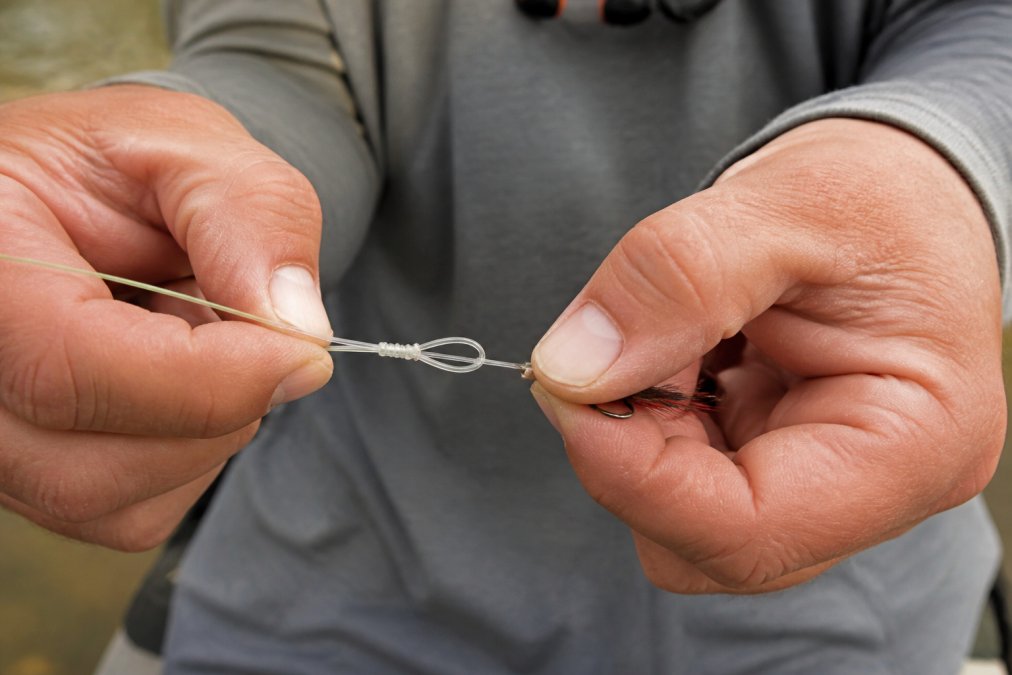
The Non-Slip Mono Loop
The non-slip mono loop creates a small loop connection between your tippet and the fly's hook eye. This loop allows the fly to move more freely during the drift, which can improve presentation on certain patterns. The knot is stronger than the improved clinch knot and works particularly well with fluorocarbon.
Thread your tippet through the hook eye. Wrap the tag end around the standing line once, creating a loop. Thread the tag end back through the initial loop. Wrap the tag end around the standing line five to seven times, then thread it through the final loop. Pull the standing line tight.
The non-slip mono loop can retain a high percentage of line strength when tied correctly. This can make it a preferred knot for large flies, heavy tippet, and situations where strength matters. The small loop connection also allows slight movement of the fly, which some anglers believe improves action during the presentation.
Knot Failure Analysis and Troubleshooting
Understanding why knots fail helps you prevent failures in the future. Knot failure rarely happens due to the knot design itself. Instead, failures result from improper tying, inadequate seating, or material incompatibility.
The most common failure mode is insufficient lubrication during the cinching process. When you pull a knot tight without wetting it first, friction creates heat that can weaken monofilament and fluorocarbon. Before cinching any knot, wet it with saliva or water. This reduces friction, allows the knot to seat more smoothly, and prevents material degradation.
Diameter mismatch causes failures when you use a knot unsuited for the line sizes involved. The improved clinch knot, for example, becomes unreliable when your tippet diameter is significantly smaller than your leader.
Common Mistakes to Avoid When Tying Knots
Most knot failures trace back to a handful of preventable errors. Recognizing these mistakes helps you maintain reliable connections throughout your day on the water.
Frequently Asked Questions
What is the strongest knot for fly fishing?
The improved clinch knot and the Uni knot rank among strong terminal knots, maintaining a high percentage of your tippet's breaking strength when tied correctly. For connecting backing to reel, the arbor knot provides excellent holding power. The key to strength is proper lubrication before seating the knot and avoiding diameter mismatch between your fly line and leader. Test your knots regularly by pulling with steady tension rather than jerking.
How do you tie a fly fishing leader to a fly line?
The nail knot is the traditional choice: wrap monofilament around a nail or tube, thread the fly line through the wraps, then pull tight. Modern anglers also use loop connections for easier changeover. Both methods create a reliable rigging system that handles the transition between fly line and monofilament leader. Proper seating and lubrication prevent slipping during casting.
Why do fly fishing knots fail?
Knot failure typically results from insufficient lubrication during tying, diameter mismatch between connected lines, or improper seating. Cold weather reduces monofilament flexibility, making knots prone to failure if not tied with extra care. Friction from repeated casting and poor knot integrity from careless tying are also common causes. Always test your knots before fishing and retie if you suspect weakness.
How many fly fishing knots do you really need to know?
Most anglers succeed with five core knots: the arbor knot for backing, the nail knot for fly line connection, the blood knot or surgeon's knot for leader-to-tippet, and the improved clinch knot for fly attachment. Adding the non-slip mono loop gives you a loop knot option for quick fly changes. Beginners should master these five before exploring advanced variations like the Pitzen knot or double davy knot.