 ultimate-guide
How to Read River Currents for Fly Fishing
Table of Contents
- Why Reading River Currents Matters for Fly Fishing Success
- Understanding the Three Basic Water Types: Riffles, Runs, and Pools
- Identifying Current Seams and Why Trout Hold There
- Reading Structure: Rocks, Logs, Undercut Banks, and Pocket Water
- Water Velocity, Oxygenation, and the Conveyor Belt Effect
- Mastering Fly Fishing Mending Techniques to Work Current Seams
- Reading Water in High-Pressure vs. Low-Pressure Scenarios
- Visual Indicators: Surface Ripples, Depth, and Speed
- Frequently Asked Questions
Last Updated: October 4, 2026
Why Reading River Currents Matters for Fly Fishing Success
Understanding how to read river currents fly fishing separates consistent anglers from those casting blindly. Water follows predictable patterns shaped by depth, rocks, logs, and riverbed structure. Learning to read these currents reveals where trout hold, feed, and how to present your fly naturally into their strike zone.
At Smith River Outfitter Raleigh Fly Fishing, we help anglers understand current seams, pocket water, and how structure creates feeding lanes.
Trout hold in specific locations for food, oxygen, and energy efficiency. Current seams deliver food continuously, the conveyor belt effect. Deep pools offer refuge; riffles provide oxygenated water. Understanding these water types transforms frustrating days into productive ones.
Understanding the Three Basic Water Types: Riffles, Runs, and Pools
Every river contains three fundamental water types, and each one requires a different approach to reading currents and positioning your fly.
Riffles: Fast, Shallow, Oxygenated Water
Riffles are shallow, broken water where current moves fast over rocky or gravelly bottoms, tumbling and aerating to create the oxygenated environment trout need.
In riffles, trout position themselves in subtle current breaks, behind rocks, or where fast water meets slower flow. The challenge is spotting micro-currents and eddies where trout actually hold rather than casting into the fastest, most obvious current.
Riffles suit dry fly fishing and nymphing; the broken surface hides your line and leader, and aggressive feeders take readily with reasonably natural presentation.
Runs: The Consistent Middle Ground
Runs are medium-depth water with moderate, consistent current, faster than pools but lacking riffles' broken surface. They form where riffles transition to deeper water or where riverbed gradient becomes consistent.
Trout in runs position themselves at current seams, invisible boundaries where fast meets slow water. A trout at a seam expends minimal energy while current delivers steady food. Runs offer the most consistent fishing with predictable holding water.
Identify current seams by watching for subtle changes in water surface texture, color shifts, or different water speeds, these pinpoint trout positions.
Pools: Deep Holding Water and Feeding Lanes
Pools are the deepest river sections where current slows. Larger trout occupy them for refuge and established feeding lanes along bordering current seams.
Pools appear uniform but current still flows through them. Feeding trout position themselves along edges where current seams form. Pool heads, where faster water enters, are often more productive than the middle or tail.
Deep pools suit nymphing; trout have time to inspect your fly. Dry fly fishing works well in morning or evening when trout rise.
Identifying Current Seams and Why Trout Hold There
Current seams are the invisible boundaries where fast water meets slow water. They're the most important feature to learn when developing your ability to read river currents fly fishing.
What Creates a Current Seam
Current seams form where obstructions or riverbed depth changes create speed differentials. Boulders force water to split and slow; drop-offs create lines where deeper, slower water meets shallower, faster water; undercut banks create backwater eddies.
Trout position themselves at seams for energy-efficient feeding. A fish faces upstream into slower water, expending minimal effort, while fast water on the other side delivers constant food.
How to Spot Seams from the Bank
Seams are often invisible from above the water; train yourself to recognize visual indicators that reveal them.
Look for surface texture changes where fast and slow water meet, subtle lines, ripple pattern differences, or color shifts mark current seams.
Watch debris movement. Leaves, foam, or twigs moving at different speeds indicate a seam.
Deeper water appears darker than shallower water. These depth changes correspond with current seams because riverbed slope creates both.
Reading Structure: Rocks, Logs, Undercut Banks, and Pocket Water
Structure creates the foundation for all current patterns in a river. Trout use structure for shelter, feeding positions, and energy conservation. Learning to identify and fish structure is essential to reading river currents effectively.
Boulders and Boulder Gardens
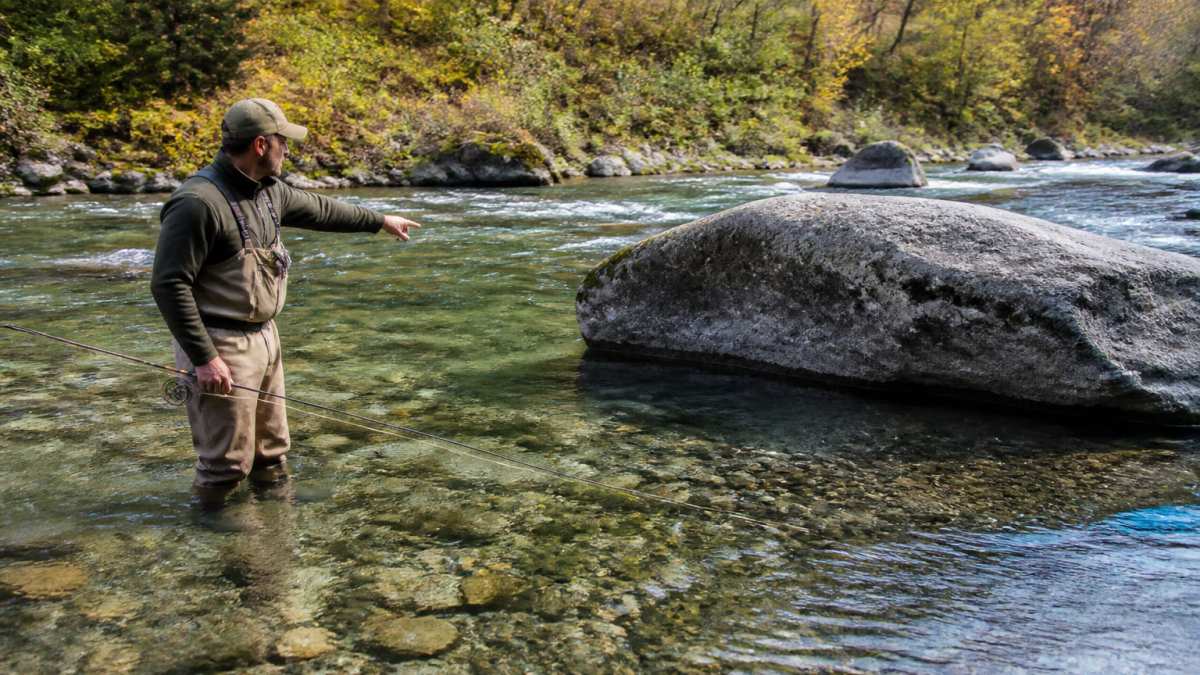
Large boulders create distinct current patterns. Water slows on the upstream side; a low-pressure pocket forms downstream where water moves slowly or reverses.
Prime holding water is the slack pocket immediately downstream of a boulder. Cast slightly upstream and let your fly drift into the pocket.
Boulder gardens create complex current patterns with numerous feeding lanes. Start with the most obvious slack water pockets, then work secondary positions.
Submerged Logs and Root Wads
Fallen trees and root wads create excellent holding water but are trickier to fish due to snags.
Water slows on the upstream side of logs, creating slack pockets where large trout hold for cover and continuous food delivery.
Cast upstream of logs and let your fly drift naturally along them. Be prepared for snags; aggressive feeders make them worth occasional lost flies.
Undercut Banks and Backwater Eddies
Undercut banks form where current erodes the riverbank, creating overhangs where water reverses. These backwater eddies offer larger trout security, depth, and access to feeding lanes.
Identify undercut banks by shadows under the bank and inward-sloping riverbanks. Water directly under moves slowly or upstream while main current flows past.
Cast into the main current just outside the eddy and let your fly drift into slower water. Trout in undercuts are selective but aggressive when they decide to take.
Water Velocity, Oxygenation, and the Conveyor Belt Effect
Trout choose locations balancing three needs: food delivery, oxygen, and energy efficiency. Understanding how velocity and oxygenation interact explains why certain water types consistently hold fish.
Fast water is oxygenated water. Riffles and run heads tumble and aerate, creating oxygen levels trout need. Food delivery and oxygen offset the metabolic expense of holding in strong current.
The conveyor belt effect is continuous food delivery by current.
Deep pools have slower current and lower oxygen levels, which is why they're less productive during the day. But larger trout often hold in pools because the depth provides security.
Understanding these principles helps you predict where trout will hold in unfamiliar water.
Mastering Fly Fishing Mending Techniques to Work Current Seams
Mending is the art of repositioning your fly line on the water to control how your fly drifts. Proper mending allows you to fish current seams effectively, presenting your fly naturally despite the complex currents pulling on your line.
The Upstream Mend
The upstream mend is the most fundamental mending technique. After your fly lands, you flip your rod tip upstream in a smooth arc, moving the line upstream without moving the fly significantly. This removes slack that would otherwise cause drag.
Use upstream mends when faster current is pulling your fly line downstream faster than your fly drifts. By moving line upstream, you maintain a direct connection to your fly, allowing it to drift naturally at the speed of the current it's in.
Upstream mends are essential for dry fly fishing and nymphing in runs and riffles where you need a drag-free drift.
The Downstream Mend and Stack Mend
The downstream mend flips line downstream, which is useful when slower current near your fly is allowing faster current on your line to pull your fly unnaturally fast. By moving line downstream, you create slack that allows your fly to drift at the natural speed of the water it's in.
The stack mend is an aggressive version where you pile extra line on the water upstream of your fly. This creates maximum slack, allowing your fly to drift naturally through complex current seams for several seconds before drag develops. Stack mends are invaluable for nymphing through boulder gardens and other complex structure.
Mending for Nymphing in Micro-Currents
Nymphing in micro-currents, the tiny current variations around structure and seams, requires precise mending. Small, frequent mends are better than large, dramatic ones. Your goal is to maintain a nearly-straight line from your rod to your fly while allowing the nymph to drift at the natural speed of the water.
In tight structure, make small upstream mends frequently to keep pace with the fly. This requires attention and practice, but it's the difference between fishing nymphs effectively and just dragging them through the water.
Reading Water in High-Pressure vs. Low-Pressure Scenarios
River conditions change constantly, and your ability to read currents must adapt to those changes. High-pressure and low-pressure scenarios require different strategies.
High-pressure days, bright sun, low water, clear conditions, make trout cautious. They position themselves in deeper, more protected water.
Low-pressure scenarios, overcast skies, higher water, slightly stained conditions, activate trout. They feed more aggressively and position themselves in faster water where food is more abundant.
In both scenarios, the fundamental principle remains: read the currents, identify where trout must hold to balance their energy needs with food delivery, and present your fly naturally in those locations.
Visual Indicators: Surface Ripples, Depth, and Speed
Surface ripple patterns indicate current speed and direction. Smooth water suggests slow current or slack water. Broken, chaotic surface indicates fast current.
Water color and clarity reveal depth. Darker water is usually deeper. Lighter, clearer water is typically shallower.
Watch how the water surface reflects light. Faster water reflects light differently than slow water.
Pay attention to debris movement. Foam, leaves, and small twigs move at the speed of the current they're in.
Reading river currents is a skill that develops through practice and observation, but it's the foundation of consistent fly fishing success.
| Technique | Best For | Key Principle |
|---|---|---|
| Upstream mend | Dry flies, faster current | Remove slack, maintain drag-free drift |
| Downstream mend | Slower current zones | Create slack for natural drift |
| Stack mend | Nymphing complex structure | Maximum slack through seams |
| Visual reading | All scenarios | Surface texture reveals current speed |
| Structure targeting | All water types | Fish hold at structure for energy efficiency |
Frequently Asked Questions
How do you identify trout-holding water in a river?
Trout hold in areas where they can feed with minimal energy expenditure. Look for current seams where fast and slow water meet, allowing trout to access the food conveyor belt without fighting heavy flow. Structure like rocks, logs, and undercut banks creates breaks in current. Depth matters too, trout typically hold in water 2-4 feet deep where they feel secure. Oxygenated water in riffles and runs attracts trout, especially in warmer months. Start by reading the overall river structure from the bank, then focus on specific pockets where these elements combine.
What is the best current speed for fly fishing trout?
Moderate current, roughly 1 to 3 feet per second, is ideal for most trout fishing. Too fast (over 4 feet per second in high water), and trout exhaust themselves fighting the flow; too slow, and they move to deeper pools or slack water. The sweet spot is where water moves steadily without excessive turbulence. This is why current seams are so productive: trout position themselves at the edge where they access flowing water without full exposure to its force. In high-pressure scenarios with heavy flow, focus on backwater eddies and slack pockets. In low-pressure conditions with minimal current, fish deeper pools and undercut banks where trout feel more secure.
How do surface ripples indicate depth and structure?
Surface texture reveals what's happening below. Smooth, glassy water usually indicates deeper pools or slack current. Visible ripples and texture suggest shallow, faster water. Boils and upwelling patterns mark submerged structure like large boulders or deep depressions where water is forced upward. Broken, choppy surface indicates riffle water with fast flow and oxygenation. Lines of foam and debris follow current seams, showing you exactly where fast and slow water meet, prime holding zones. Practice reading these visual cues from the bank before wading, and you'll quickly spot where trout are likely to be positioned.
What is the difference between a riffle, run, and pool for fly fishing?
Riffles are shallow, fast-moving water with visible turbulence and high oxygenation, excellent for nymphing and dry fly fishing in cooler months. Runs are moderate-depth, moderate-speed sections where water moves steadily without heavy turbulence, versatile water for both dry flies and nymphs. Pools are deeper, slower water where trout rest and feed during warmer periods or high-pressure days. Each water type holds trout at different times depending on season, temperature, and flow rates. Learning to identify and fish all three effectively gives you options across changing conditions.