 how-to
Learn Fly Fishing: A Beginner's Guide
Table of Contents
- What You'll Need Before You Start
- Fly Fishing Gear for Beginners: Essential Equipment
- Fly Fishing Casting Techniques for Beginners
- NC Wildlife Fishing License Requirements
- Where to Practice and Fish Locally
- Learning Paths: Self-Taught vs. Guided Instruction
- Essential Skills Beyond the Cast
- Your First Outing: What to Expect
- Frequently Asked Questions
Last Updated: September 23, 2026
What You'll Need Before You Start
To learn fly fishing doesn't require buying everything at once. At Smith River Outfitter Raleigh Fly Fishing, we offer guided trips that include equipment, allowing you to test the sport without financial pressure.
Fly Fishing Gear for Beginners: Essential Equipment
You need four main categories of equipment to start. Understanding each one helps you make smart purchasing decisions when you're ready to invest.
Rods, Reels, and Lines
Beginner fly rods are typically 8 to 9 feet long and weigh 4 to 6 ounces. A simple mechanical reel holds your line and provides drag. Most beginners use a weight-forward floating line, which makes casting easier and helps present flies naturally.
Key components:
- Fly rod: 8-9 feet, 4-6 weight
- Reel: mechanical, smooth drag
- Line: weight-forward floating line
- Backing: 100-150 yards of braided backing
Waders and Footwear
Chest waders offer more coverage for deeper water; waist-high waders suit shallow streams. Most beginners choose neoprene waders for warmth and durability. Felt-soled wading boots provide excellent traction on wet rocks; rubber soles work on sandy or muddy banks.
Wader essentials:
- Chest or waist waders (neoprene for beginners)
- Wading boots with felt soles
- Wading belt (prevents water entry if you slip)
- Warm base layers underneath
Tackle and Fly Selection
Your fly box holds artificial flies that imitate insects or small fish. Start with dry flies (float on surface), nymphs (sink below surface), and streamers (mimic small fish). A small selection of proven patterns works better than dozens of options.
A basic starter set includes:
- 6-8 dry fly patterns (Adams, Elk Hair Caddis, Parachute Hatch)
- 6-8 nymph patterns (Pheasant Tail, Hare's Ear, Prince Nymph)
- 3-4 streamer patterns (Wooly Bugger, Muddler Minnow)
Fly Fishing Casting Techniques for Beginners
Casting separates fly fishing from other angling methods. It feels awkward at first, but practice makes it natural.
The Basic Grip and Stance
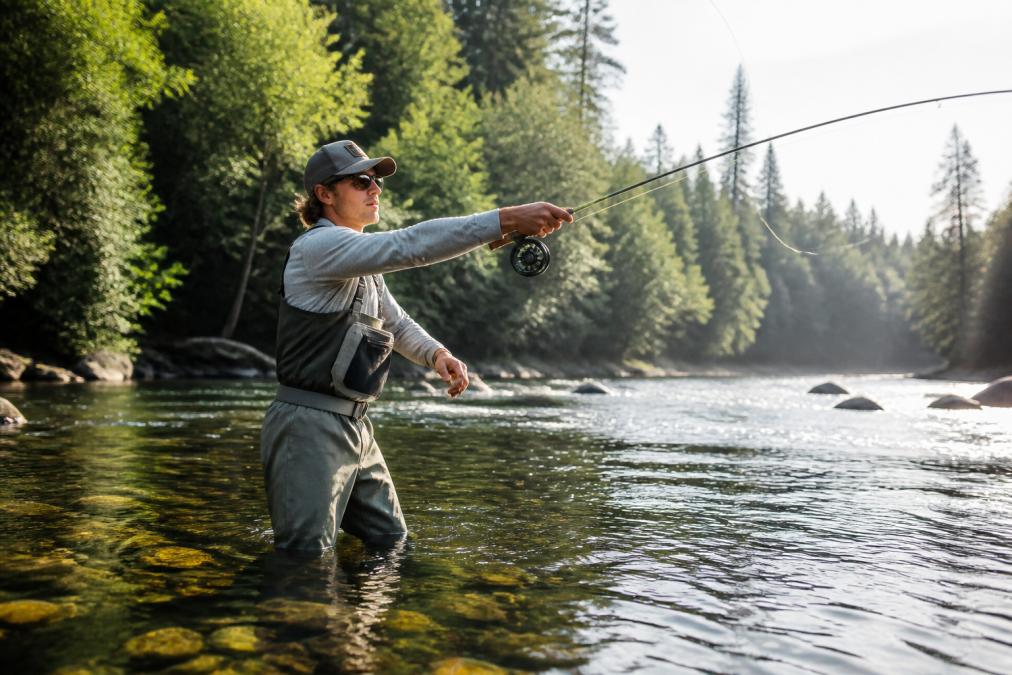
Hold the rod handle with your fingers wrapped around the cork grip and your thumb on top, pointing straight down the rod. Keep your grip relaxed, tension disrupts your cast. Stand with feet shoulder-width apart at a 45-degree angle to the target, with weight centered to generate power from your whole body, not just your arm.
Proper grip and stance:
- Thumb on top of handle, pointing down the rod
- Fingers wrapped loosely around cork
- Feet shoulder-width apart at 45-degree angle
- Weight centered and balanced
The Backcast and Forward Cast
Start with 20-30 feet of line outside the rod tip. Accelerate the rod backward smoothly to the 1 o'clock position, pause briefly to let the line straighten, then accelerate forward smoothly to the 10 o'clock position. Smooth acceleration beats jerky movements.
The casting sequence:
- Start with 20-30 feet of line extended
- Accelerate backward to 1 o'clock position
- Pause and let line straighten
- Accelerate forward to 10 o'clock position
- Follow through smoothly
Common Casting Mistakes to Avoid
Casting too hard is the most common beginner mistake, power comes from acceleration, not muscle. Stop the rod at 10 o'clock, not earlier. Drive the cast with your forearm and upper arm, not your wrist. Pause briefly between backcast and forward cast, or the line will drop.
NC Wildlife Fishing License Requirements
You need a valid fishing license if you're over 16 years old. Purchase online for instant delivery. Resident licenses cost less than non-resident licenses; visitors can buy short-term licenses valid for 3 days, 7 days, or a full year. Trout fishing in designated areas requires an additional trout stamp.
License basics:
- Required for anglers 16 and older
- Purchase online for instant delivery
- Resident and non-resident options available
- Short-term licenses available for visitors
- Trout waters may require additional stamps
Where to Practice and Fish Locally
This region offers excellent beginner-friendly waters. Urban parks provide convenient access. Local streams offer more challenging but rewarding opportunities.
Urban Parks and Beginner-Friendly Waters
Parks near the city center have small ponds and streams with fewer obstacles and calmer currents, ideal for practicing your cast. Bluegill and bass in park ponds are more forgiving than trout and provide good practice for presentation skills. Local fly shops can point you toward specific spots where beginners catch fish.
Public Access Areas and Watershed Zones
The state maintains public access areas along several streams with parking and facilities. Fishing is allowed in most watershed areas, but regulations may be stricter. Trout Unlimited chapters maintain some public access areas and connect you with experienced anglers.
Finding public access:
- Check state wildlife website for designated areas
- Visit local Trout Unlimited chapter website
- Ask at fly shops for current access information
- Look for parking areas and posted access signs
- Respect private property and posted restrictions
Learning Paths: Self-Taught vs. Guided Instruction
You can learn fly fishing on your own or with professional guidance. Your choice depends on your learning style and timeline.
DIY Practice and Online Resources
YouTube offers free casting tutorials; watch several instructors as different explanations click with different learners. Practice in your yard with cones or targets to build muscle memory. Books, websites, and online communities like Reddit's r/flyfishing provide support, but self-teaching requires patience and takes longer than guided instruction.
Self-taught resources:
- YouTube casting tutorials (search "fly casting basics")
- Books on fly fishing fundamentals
- Online forums and communities
- Practice in your yard before fishing
- Local fly shop staff (often helpful without charge)
Why Professional Guidance Accelerates Your Progress
A guide spots and fixes casting mistakes immediately, making clear in an hour what takes weeks to discover alone. Guides know where fish are and what they're eating, eliminating guessing. Professional instruction builds confidence quickly, catching fish on your first outing is possible with a guide. Smith River Outfitter Raleigh Fly Fishing offers guided trips combining instruction with fishing.
Benefits of guided instruction:
- Immediate feedback on your casting
- Local knowledge of where fish are
- Increased success on your first outing
- Confidence building through early success
- Personalized instruction matched to your learning style
Essential Skills Beyond the Cast
Casting is just the beginning. Other skills determine whether you catch fish consistently.
Knot Tying and Leader Setup
Your leader connects the fly line to the tippet, which holds the fly. Master the improved clinch knot (fly to tippet), surgeon's knot (joining line sizes), and arbor knot (backing to reel). Practice at home so muscle memory helps when conditions are cold and wet. A 9-foot leader works for most situations; use longer leaders (12 feet) in clear water and shorter leaders (6 feet) in heavy current.
Essential knots:
- Improved clinch knot (fly to tippet)
- Surgeon's knot (joining line sizes)
- Arbor knot (backing to reel)
- Clinch knot (line connections)
Reading Water and Seasonal Patterns
Current breaks behind rocks create resting spots, deep holes hold larger fish, and shallow riffles attract feeding fish. Seasonal patterns shift fish location: spring high water pushes them to slower areas, summer heat drives them deep, fall cooling brings them to shallower water. Match the hatch by using flies that look like insects currently hatching.
Water reading basics:
- Current breaks behind rocks hold resting fish
- Deep pools hold larger fish
- Shallow riffles attract feeding fish
- Undercut banks provide cover
- Overhanging trees create shade and food sources
Your First Outing: What to Expect
Your first fly fishing experience will feel different from other angling, but success comes faster than you might expect. Plan for a half-day outing to practice without exhaustion. Expect to miss fish, even experienced anglers do. Overcast days are often better than bright sun; wind makes casting harder, and rain can trigger feeding activity.
First outing checklist:
- Check weather forecast
- Bring water and snacks
- Wear layers (temperature changes throughout the day)
- Apply sunscreen (water reflects UV rays)
- Start with short casts and work outward
- Focus on technique, not catching fish
| Learning Method | Time to Competence | Cost | Best For |
|---|---|---|---|
| Self-taught | 8-12 weeks | Low | Patient learners, visual learners |
| Guided instruction | 1-2 outings | Higher | Beginners wanting quick success |
| Hybrid approach | 4-6 weeks | Moderate | Balanced learning and cost |
| Water Type | Best Species | Difficulty | Season |
|---|---|---|---|
| Park ponds | Bluegill, bass | Easy | Spring-fall |
| Streams | Trout | Moderate | Spring, fall |
| Rivers | Trout, smallmouth | Hard | Year-round |
| Gear Item | Beginner Budget | Purpose |
|---|---|---|
| Fly rod and reel | Rent first | Cast and retrieve line |
| Waders | Neoprene recommended | Stay dry and warm |
| Flies | Start with 12-15 | Imitate natural insects |
| Boots | Felt-soled | Grip on rocks |
Frequently Asked Questions
Do I need a fishing license to fly fish in North Carolina?
Yes. North Carolina requires all anglers 16 and older to hold a valid fishing license. You'll need a freshwater license to fish inland waters. The NC Wildlife Resources Commission issues licenses online, at sporting goods retailers, and through authorized agents. A resident annual license covers all freshwater species, including trout. Licenses are affordable and support habitat conservation and public access programs.
What's the best way for a beginner to learn fly fishing?
Start with the fundamentals: grip, stance, and the basic forward and backcast. Practice on grass or in a park before hitting the water. Learn knot tying and fly selection alongside casting. Many beginners find that combining self-taught practice with professional instruction accelerates progress significantly. A guide can diagnose casting flaws in real time and teach water-reading skills that YouTube alone cannot convey.
What fly fishing gear do beginners actually need?
A 9-foot fly rod (4-6 weight) paired with a matching reel forms the core. You'll need a weight-forward floating line, backing, and a leader with tippet. Waders keep you dry in the water. A fly box with assorted dry flies, nymphs, and streamers covers most situations. Many beginners rent or borrow gear initially to avoid buying expensive equipment before confirming they enjoy the sport.
Where can I practice fly fishing near Raleigh?
Urban parks with ponds and slow-moving streams offer ideal beginner spots. Public access areas along local watersheds provide productive water without crowds. State-managed trout waters and public fishing areas are designated by the NC Wildlife Resources Commission. Starting in calm, shallow water helps you focus on casting mechanics before tackling moving currents or deeper pools.