 how-to
How to Set the Hook Fly Fishing: A 2026 Step-by-Step Guide
Table of Contents
- What You'll Need Before You Practice Your Hook Set
- Step 1: Read the Take and Decide When to Set the Hook
- Step 2: Choose Between the Strip Set and the Rod Lift
- Step 3: Manage Slack and Set the Hook in the Right Direction
- Using Fly Fishing Strike Indicators to Time Your Set
- How to Detect Subtle Trout Strikes on Different Flies
- Common Mistakes to Avoid When Setting the Hook
- Equipment Adjustments for a Better Hook Set
- Frequently Asked Questions
Last Updated: September 28, 2026
What You'll Need Before You Practice Your Hook Set
You can learn how to set the hook fly fishing with just a rod, a line, and a patch of grass. The motion is simple; the timing is not.
Here is what to gather before you practice:
- A 9-foot, 5-weight rod with matching line
- A leader tapered to 4X or 5X tippet
- A small piece of yarn or a barbless hook
- A lawn, a driveway, or open water
Step 1: Read the Take and Decide When to Set the Hook
The take is the moment a fish eats your fly. Reading it correctly decides whether you hook up or pull the fly away.
Dry Fly Takes vs. Nymph Takes
A dry fly take happens on the surface: the fish rises, mouths the fly, and turns down. Set the hook as the fish turns.
Step 2: Choose Between the Strip Set and the Rod Lift
The strip set and the rod lift are the two core ways to set the hook. Pick based on the fly you are fishing, not on habit.
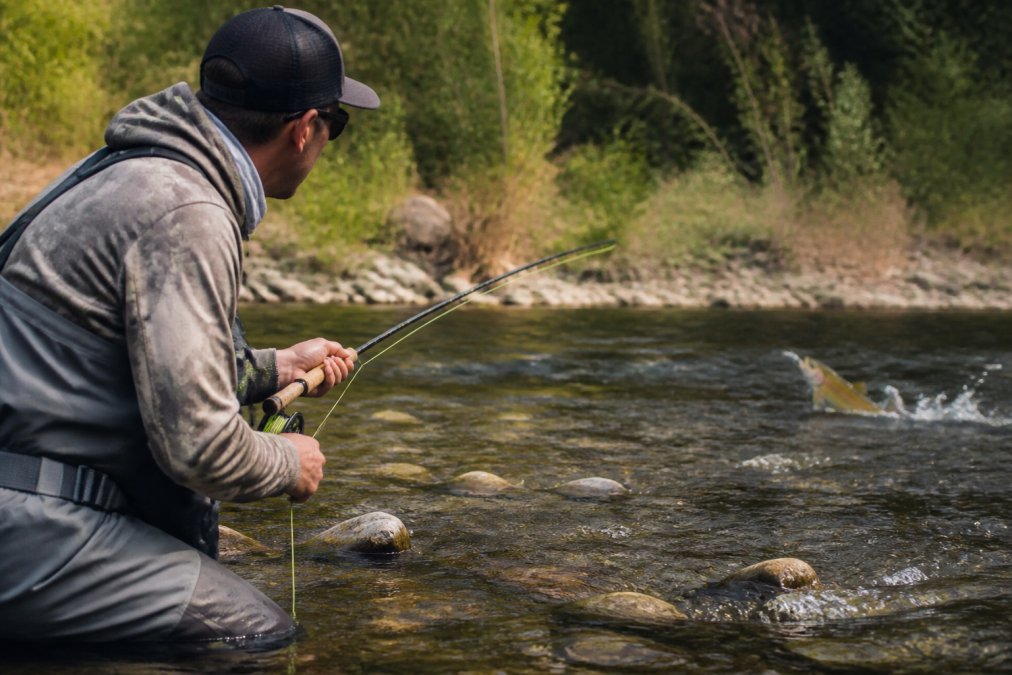
The Strip Set for Streamers and Nymphs
Use the strip set for streamers, nymphs, and anything fished under the surface. Keep the rod tip low and pointed at the fly. When you feel weight, pull the line hard with your free hand. The rod barely moves. That low angle drives the hook point straight into the fish's jaw.
The Rod Lift for Dry Flies
Use the rod lift for dry flies. Lift the rod tip up and slightly downstream in one smooth motion. Do not jerk. A slow, firm sweep sets the hook without snapping your tippet.
Step 3: Manage Slack and Set the Hook in the Right Direction
Slack line is the number one reason hook sets fail. If your line is curved on the water, your pull never reaches the hook.
Using Fly Fishing Strike Indicators to Time Your Set
A strike indicator is a float that turns an invisible subsurface take into a visible one. It is a signaling device, not a bite alarm, the skill is knowing which movements mean a fish and which mean the bottom.
What Each Indicator Movement Actually Means
| Indicator behavior | Most likely cause | Correct response |
|---|---|---|
| Sharp dip straight under | Fish ate the nymph and closed its mouth | Set now, downstream and parallel to the water |
| Brief pause, then resumes drifting | Nymph ticked structure or a fish mouthed and rejected | Do not set; check depth and drift |
| Sideways twitch against the drift | Fish took and turned, or line caught a cross-current | Set if the twitch is sudden; if it repeats in the same seam, it is drag |
| Slow sink with no rebound | Nymph snagged bottom | Do not set; free it and adjust depth |
| Accelerates downstream | Fish took and is moving with the current | Set immediately; the fish is already hooked or about to drop it |
| Rhythmic bounce in the same spot | Indicator riding chop or a riffle seam | Do not set; reposition upstream |
Why the Pause Is the Real Signal
A trout that takes a nymph typically closes its mouth and holds for a fraction of a second before rejecting. That closure stops the indicator, the pause is the take, the dip the confirmation.
Reading the Indicator Against the Current
Set the indicator so it drifts at the same speed as the current seam your nymph is fishing. Faster than the bubbles around it means your nymph is dragging and riding high; slower means it is on the bottom or hung up.
Indicator Types and How They Change Your Set
- Yarn or New Zealand-style indicators: sensitive to the lightest pause, but they absorb water and can sink. Set on the pause, not the sink.
- Foam or cork bobbers: buoyant and visible at distance, but they add drag. Expect a slightly delayed signal and set a touch sooner.
- Air-lock or twist-on indicators: adjustable depth without re-rigging. Best for deep pools where the nymph needs to ride low.
- Dry-dropper rigs: the dry fly is the indicator. Set when the dry fly disappears, stalls, or drags unnaturally, not when a fish splashes at it.
The Half-Second Rule
On a nymph, give the fish a half-second after the indicator signals so it can close its mouth and turn. On a dry fly, set as the fish turns down. On a streamer, set the instant you feel weight. The half-second is not hesitation, it is the difference between a hook in the jaw and a fly pulled out of the lips.
How to Detect Subtle Trout Strikes on Different Flies
Learning how to detect subtle trout strikes comes down to watching the right thing for each fly type. Trout often take and reject a fly in under a second.
Common Mistakes to Avoid When Setting the Hook
The biggest mistake is the trout set: a hard, upward jerk borrowed from bass fishing. It snaps tippet and pulls small flies out of a fish's mouth.
Other common errors:
- Setting too hard and breaking off fish
- Setting too late and missing the take
- Leaving slack in the line
- Setting upstream into a fish facing upstream
- Using the rod lift on a streamer
Equipment Adjustments for a Better Hook Set
Most guides tell you to "match your set to your setup" and stop there. The useful version is mechanical: your rod, tippet, and hook each absorb or transmit force, and the set only works when enough force reaches the hook point to drive it past the barb.
How Rod Action Changes the Force You Deliver
Rod action describes where the rod bends under load, determining how much of your pull reaches the hook versus how much disappears into the blank.
- Fast-action rod: bends mostly in the upper third. It transmits force quickly and with less loss, so a short, firm strip set is enough. Over-powering a fast rod on fine tippet is the most common way to pop a fish off.
- Medium-action rod: bends through the middle. It is the most forgiving for beginners because it softens the peak of the strike without deadening the signal.
- Slow-action rod: bends deep into the butt. It stores energy and releases it slowly, which protects light tippet but requires a longer, smoother lift to move the hook. A sharp jerk on a slow rod often just flexes the blank.
How Tippet Diameter and Material Change the Equation
Tippet does two things at once: it transmits force and it stretches. Both matter.
- Nylon tippet stretches noticeably under load. That stretch absorbs part of your strike, which protects the tippet but also softens the hook set. On fine nylon, use a longer, smoother pull rather than a snap.
- Fluorocarbon tippet stretches less and sinks faster. It transmits more force to the hook, which is an advantage on a firm set and a liability on a violent one.
- 6X and lighter: treat every set as a smooth, controlled pull. The margin between a hook-up and a break-off is small.
- 4X and 3X: you have room to pull firmly, especially on streamers and larger nymphs.
- 0X and 1X: reserved for big streamers, bass, and saltwater. A hard strip set is appropriate here.
Hook Gap, Wire, and Point Geometry
The hook itself is the last link in the chain, and the one most anglers ignore.
- Hook gap is the distance between the point and the shank. A wider gap grabs more jaw. A narrow gap on a thick-jawed fish will not penetrate no matter how hard you pull.
- Wire diameter determines how much force is needed to drive the point. Fine-wire hooks penetrate with light tippet and gentle sets. Heavy-wire hooks need more force and are better suited to stout tippet.
- Barbless hooks penetrate more easily and release more easily. They reward a smooth, firm set and punish a slack one.
- Hook point condition matters more than any other variable. A rolled or dulled point will skate across a jaw. Check the point on every fly change by dragging it across your thumbnail. If it does not bite, sharpen or replace it.
Matching the Set to the Whole System
| Rod action | Tippet | Recommended set |
|---|---|---|
| Fast | 5X-6X | Short, firm strip set; keep rod tip low |
| Fast | 3X-4X | Firm strip set or smooth rod lift |
| Medium | 4X-5X | Smooth rod lift or moderate strip set |
| Slow | 5X-6X | Long, smooth rod lift; avoid sharp jerks |
| Any | 0X-2X | Hard strip set for streamers and big fish |
The Drag Setting You Forgot
If you fish a reel with an adjustable drag, set it light enough that a running fish can take line without breaking tippet, but firm enough that the hook stays seated. Too tight turns a head shake into a break-off; too loose lets the fish spit the hook on slack.
Frequently Asked Questions
What is the most common mistake beginners make when setting the hook?
The most common mistake is lifting the rod too hard and too fast, which can snap the tippet or pull the hook out of a trout's mouth. Beginners also tend to set the hook too early, before the fish has taken the fly. Instead, wait until you feel the weight of the fish, then use a smooth strip set or a gentle rod lift. Practicing on the water with a guide can help you develop the right timing and pressure.
How do you know when to set the hook while fly fishing?
Watch for the take: a sudden stop, a twitch in the line, or the indicator dipping. For dry flies, wait until the fish's mouth closes on the fly. For nymphs, set when the indicator pauses or dives. If you see the fish turn, that's a good sign. The key is to set the hook after the fish has taken the fly, not before. Using fly fishing strike indicators can help you see subtle takes more clearly.
Is there a difference between setting the hook for dry flies versus nymphs?
Yes. Dry flies usually call for a downstream rod lift, while nymphs often require a strip set to keep the hook point moving horizontally. For dry flies, wait a split second after the rise, then lift the rod tip smoothly. For nymphs, set the hook with a quick strip of the line, especially when using heavy nymphs or streamers. Adjusting your technique to the fly type increases hook-up rates.
How much pressure should you apply when setting the hook?
Apply just enough pressure to drive the hook point into the fish's mouth, but not so much that you break your tippet. With a strip set, pull the line firmly but smoothly. With a rod lift, raise the rod tip quickly but without jerking. The goal is to tighten the line and set the hook, not to haul the fish in. Using a lighter tippet requires less force. Let the rod and reel do the work after the hook set.