 ultimate-guide
How to Fly Fish for Beginners: A 2026 Step-by-Step Guide
Table of Contents
- What You'll Need Before Your First Cast
- Fly Fishing Gear for Beginners: What to Buy First
- How to Cast a Fly Rod: Your First Three Casts
- Basic Fly Fishing Knots Every Beginner Should Know
- Reading the Water: Where Fish Actually Hold
- Fly Fishing Etiquette for Beginners: Sharing the Water Well
- Common Beginner Mistakes and How to Avoid Them
- Frequently Asked Questions
Last Updated: September 15, 2026
What You'll Need Before Your First Cast
Learning how to fly fish for beginners starts with one honest truth: you need less than you think, and more patience than you expect. Fly fishing casts a weighted line rather than a weighted lure, which is why the gear looks different and the learning curve feels steep. This guide covers gear, casting, knots, and water reading so your first trout stream outing feels controlled instead of chaotic.
Before you leave the house, you need four things: a rod and reel matched to the fish you're chasing, a weight-forward line, a leader and tippet, and a small fly box with a handful of patterns. Add polarized sunglasses, a landing net, and waders if you plan to wade.
The American Sportfishing Association's fishing participation data shows that fly fishing remains one of the fastest-growing segments of recreational angling, which means shops and guides now cater heavily to newcomers. You are not the first person to show up unsure.
Fly Fishing Gear for Beginners: What to Buy First
Buy the rod weight that matches your local water, not the one a forum told you to buy. For most beginners on a trout stream, a 5-weight rod is the correct starting point. It casts small dry flies, nymphs, and light streamers well enough to learn on without fighting the rod.
Rod, Reel, and Line: The Three Essentials
The rod carries the cast, the reel mostly stores line, and the line delivers the fly. A beginner's fly reel is a line holder with a drag, and that is fine. Spend your money on the rod and the line instead.
A weight-forward line concentrates most of its mass toward the front, which makes short casts easier for new anglers. Pair it with a tapered leader and a spool of tippet, and you can fish most situations in your first season.
Budget-Conscious Gear Assembly
Don't buy a full premium setup before your first trip. Assemble a starter kit in stages, and upgrade only what limits you.
| Priority | Item | Why It Matters | When to Upgrade |
|---|---|---|---|
| 1 | 5-weight rod and reel combo | Covers most trout water | After one full season |
| 2 | Weight-forward floating line | Makes short casts manageable | When it cracks or sinks |
| 3 | Leader and tippet spools | Connects fly to line | Consumable, replace often |
| 4 | Small fly box with 6-8 patterns | Covers dry fly and nymphing | As you learn your water |
| 5 | Polarized sunglasses and landing net | See fish, land them safely | Lasts for years |
How to Cast a Fly Rod: Your First Three Casts
The fly cast is a smooth acceleration and stop, not a throw. You load the rod with the weight of the line, then let that stored energy shoot the line forward. Beginners who muscle it snap flies off and tangle leaders.
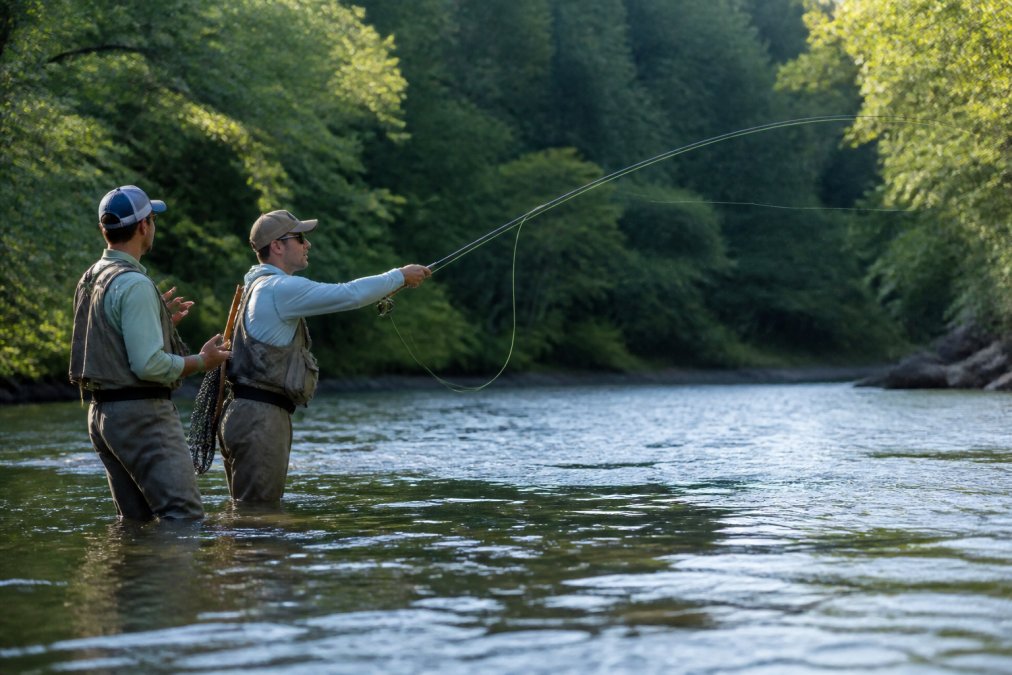
Practice on grass before you stand in moving water. Set a target, strip out about 20 feet of line, and work through these casts in order.
The Roll Cast
The roll cast is the first cast every beginner should learn because it works when brush or a bank is behind you. Lift the rod, let the line drape behind your shoulder, then drive forward to roll the line out. It keeps you fishing where a back cast is impossible.
The False Cast
The false cast is a repeated forward-and-back motion that builds line speed and dries your fly.
Basic Fly Fishing Knots Every Beginner Should Know
- Arbor knot, backing to reel spool. Tied once per season, not per trip.
- Nail knot or loop-to-loop connection, fly line to leader. The loop-to-loop is faster and lets you swap leaders without cutting line.
- Blood knot, joins two tippet sections of similar diameter when you need to extend a leader.
- Improved clinch knot, tippet to fly. This is the knot you'll tie dozens of times per outing.
How to Tie the Improved Clinch Knot
- Thread the tippet through the hook eye, leaving about six inches of tag end.
- Wrap the tag end around the standing line five to seven times. Five is fine for light tippet; seven for heavier.
- Pass the tag end through the small loop just above the hook eye.
- Pass it back through the large loop you just created. That extra pass is what makes it "improved."
- Wet the knot with saliva or stream water, then pull the standing line and tag end in opposite directions until it seats snug against the hook eye.
- Trim the tag end close, but not so close you nick the knot.
How to Tie the Arbor Knot
Knots You Can Skip for Now
Beginners see long lists of knots and assume they need all of them.
Practice Routine That Actually Works
Knot Maintenance and Line Care
Reading the Water: Where Fish Actually Hold
Fish hold where current meets cover and where they can feed without fighting the flow.
The Four Water Types to Learn First
Riffles are shallow, broken stretches where water tumbles over rocks.
How to Find a Seam
A seam is the visible line where two currents of different speeds meet.
Where Fish Sit in a Trout Stream
- Behind rocks and boulders. The cushion of slow water on the downstream side is a classic holding lie.
- Under cut banks. Undercut banks give fish shade and overhead cover. Cast tight to the bank.
- At the head of a pool. Where the riffle dumps into the pool, fish stack up to feed on what the current delivers.
- Along weed beds and submerged structure. Cover plus food equals fish.
- In the tailout of a pool. Shallow, fast, and often overlooked, and often holding the biggest fish in the pool at low light.
Water Temperature and Season
Trout feed most actively when water is in the mid-50s to mid-60s Fahrenheit.
Position Yourself Before You Cast
- Approach from downstream. Fish face upstream. Walking up from behind them keeps you out of their cone of vision.
- Stay low. Crouch behind banks, rocks, and brush. A silhouette against the sky spooks fish faster than a bad cast.
- Watch before you wade. Stand still for a full minute at each new spot. You'll often see a rise form or a flash that tells you exactly where to cast.
Use a Fishing Report, But Verify It
Fly Fishing Etiquette for Beginners: Sharing the Water Well
Common Beginner Mistakes and How to Avoid Them
Other mistakes worth avoiding:
- Fishing dry flies when nothing is rising. If there's no hatch and no rise form, switch to nymphing or a streamer.
- Ignoring the leader and tippet. A worn tippet breaks on the strike. Replace it often.
- Wading too deep too fast. Move slowly, use a wading staff, and watch the current.
- Skipping maintenance. Rinse your reel, dry your line, and check guides for nicks. A little care extends gear life by seasons.
Frequently Asked Questions
Can you teach yourself to fly fish?
You can learn the basics from videos and books, but casting is the hardest part to self-correct without feedback. Most beginners who practice alone develop a wrist-heavy casting stroke that collapses the loop. A half-day lesson or guided trip shortens the learning curve considerably because someone can watch your cast and adjust it in real time. Start with a local shop or guide, then practice on your own between trips.
What gear do I need to start fly fishing?
You need five things: a rod, a reel, a weight-forward floating line, a leader, and a few flies. A 9-foot 5-weight rod covers most trout and panfish situations. Add nippers, forceps, a landing net, and polarized sunglasses. Waders help in cold water but aren't required in summer. Many guides provide loaner gear, so you can try before buying your own setup.
How do you read the water when fly fishing?
Look for seams, riffles, and foam lines where current slows and food collects. Trout hold in the cushion of slower water next to fast current, behind rocks, and under overhanging banks. A rise form tells you fish are feeding on the surface. Watch for a few minutes before casting. If nothing shows, fish subsurface with a nymph and a drag-free drift through the likely holding lanes.
What is the hardest part of fly fishing for beginners?
Casting is the hardest skill to learn, followed closely by mending line for a drag-free drift. Beginners tend to overpower the rod and use too much wrist. The fix is to slow down, let the rod load, and stop the back cast high. Knots and fly selection come easier with repetition. Expect the first few outings to feel awkward. That's normal.