 how-to
Can Fly Fishing Guides Fix Casting? A 2026 Guide
Table of Contents
- What a Fishing Guide Can and Cannot Fix
- Common Fly Casting Mistakes Guides See Every Day
- Guide or Casting Instructor: Which Do You Need?
- How Guides Coach You on the Water
- Fly Fishing Casting Instruction Costs: What to Expect
- Pre-Trip Casting Assessment and Practice Plan
- Conclusion
- Frequently Asked Questions
Last Updated: September 25, 2026
What a Fishing Guide Can and Cannot Fix
Can fly fishing guides fix casting? Yes, a good guide can fix the most common casting faults on the water, but only within limits. A guide is a fishing coach, not a casting school. At Smith River Outfitter Raleigh Fly FIshing, we see this question before almost every trip.
Most guides correct timing, loop control, and line management in a few hours. That covers the faults that cost you fish. What a guide cannot do is rebuild your casting stroke from scratch in one day. That takes repetition over weeks.
So the honest answer sits in the middle. A guide can fix casting problems that show up under real fishing pressure. Deep mechanical habits need a dedicated instructor.
Here is what a guide can realistically handle:
- Tailing loops caused by rushing the forward cast
- Wind resistance problems from a wide, open loop
- Line management issues like line pile-up at your feet
- Target acquisition errors, such as aiming at the wrong point
- False casting that goes on too long and spooks fish
And here is what usually needs a casting instructor instead:
- A stroke built on the wrong arm motion from day one
- Grip and wrist habits that break down under load
- Distance goals beyond your current physical range
The difference matters because it sets your expectations before you ever step in the boat. A guide can sharpen your casting. A guide cannot give you a new one.
Common Fly Casting Mistakes Guides See Every Day
The same common fly casting mistakes show up trip after trip. Most come down to timing, not strength.
Tailing Loops and Timing Errors
A tailing loop happens when the rod tip dips during the cast. The line crosses itself and tangles. The cause is almost always starting the forward cast too early.
The fix is simple to say and hard to feel. Pause longer on the backcast. Let the line straighten behind you before you drive forward.
What most guides miss is that tailing loops often get worse when a client tries harder. Tension in the shoulder shortens the pause. The cast collapses. So we slow the whole thing down first, then add power.
Wind Resistance and Loop Control Problems
Wind is the great revealer. A tight loop cuts through it. A wide loop dies in it.
Most anglers open the loop without knowing. They use too much wrist and not enough rod tip travel. The fix is to keep the casting stroke on a straight plane and finish high.
On windy days, a tighter loop and a lower trajectory beat raw power every time. That is the casting puzzle in one sentence.
Guide or Casting Instructor: Which Do You Need?
Pick a guide when your casting works but your fishing does not. Pick a casting instructor when the cast itself is the problem. That is the cleanest way to decide, but it is not the whole decision.
The two roles overlap, yet they are not the same job. A guide's job is to put you on fish and adjust your presentation to the water in front of you. An instructor's job is to change the motion that sends the fly there. A guide works in real conditions with real fish and limited time. An instructor works in controlled conditions with repetition and no fish to spook.
Here is the trade-off most anglers miss: a guide can fix a fault that appears only under fishing pressure, because the pressure is present. An instructor can fix a fault that appears everywhere, because the repetition is present. Neither can do the other's job well in a single session.
Use this decision framework before you book:
| Your Situation | Best First Move | Why |
|---|---|---|
| Cast works on the lawn, collapses on the water | Guide | The fault is pressure-induced, not mechanical |
| Cast collapses in wind at any distance | Guide first, instructor if it persists | Guides fix loop control fast in real conditions |
| No consistent stroke at all, even on grass | Casting instructor | Rebuilding a stroke takes weeks of repetition |
| New to the sport | Guide | Learn on real water with real fish and real feedback |
| Chasing distance beyond 60 feet | Casting instructor | Distance work is technical and physical |
| Grip or wrist pain during casting | Instructor, then a medical professional if it persists | Mechanics and mobility, not fish location |
A common pattern is that anglers book a guide expecting a casting lesson, then spend the first hour of a paid trip on mechanics they could have addressed on a lawn for free. The reverse also happens: anglers book an instructor to fix a problem that only shows up when a fish is rising, and the fault never appears in a controlled setting.
If you are unsure, start with a guide. Most casting problems shrink once you are casting at actual fish. If the problem survives a full guided day, that is your signal to book a dedicated instructor.
How Guides Coach You on the Water
On-the-water coaching works because the feedback is instant. You cast, the guide watches, and you adjust in the same minute.
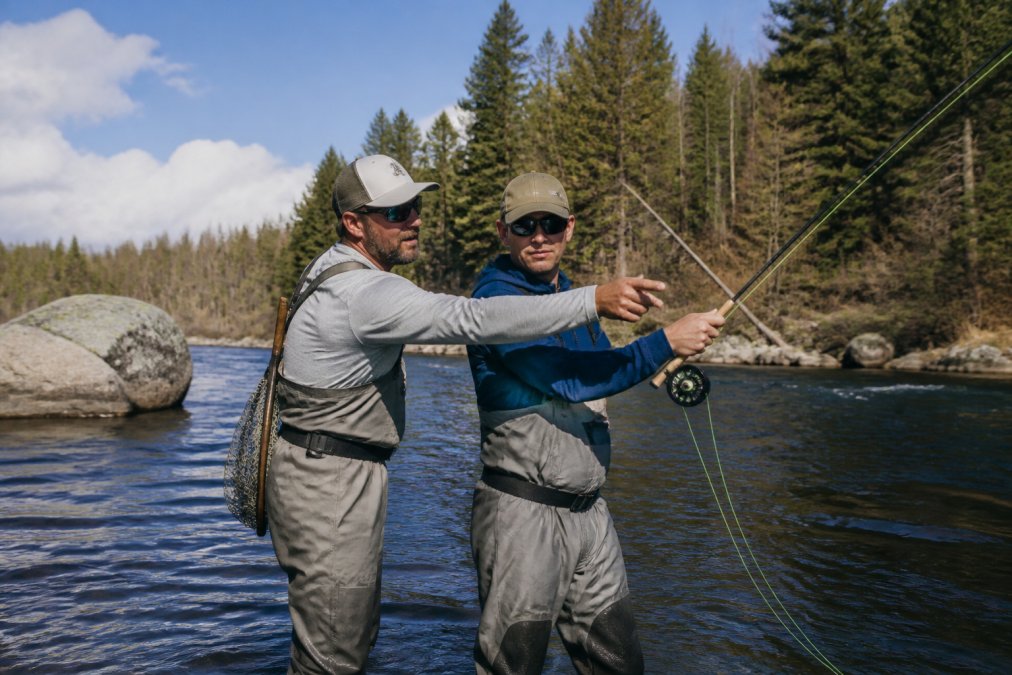
A common approach is the three-cast rule. Cast three times. If the loop is off, stop and fix the stroke before casting again. This builds muscle memory the right way.
Guides also use target acquisition drills. Pick a leaf on the water.
Fly Fishing Casting Instruction Costs: What to Expect
Fly fishing casting instruction costs depend on the format, the length of the session, and whether it happens on water or on a casting lawn. Pricing also shifts by season and group size.
A few things drive the cost:
- Session length, from a single hour to a full day
- Private versus group instruction
- On-water versus dry-land coaching
- Travel distance to your chosen water
- Season, since peak months book out first
Pre-Trip Casting Assessment and Practice Plan
Most casting advice is reactive: you show up, you cast badly, the guide fixes it. A short self-assessment before your trip flips that. It tells your guide where to focus before you ever step in the boat, and it saves hours of paid water time.
- Cast 20 feet with a tight loop, five times in a row
- Cast into a light breeze and keep the loop from opening
- False cast without letting the line drop or the loop widen
- Land the fly inside a hula hoop three times out of five
- Cast with your off hand for ten minutes
- Note which cast breaks down first when you get tired
Film Your Cast Before the Trip
Video analysis is the tool most anglers never use. Film your cast from the side, at chest height, in good light. Thirty seconds is enough. Watch it back at half speed.
Physical Conditioning for Casting
Casting is a shoulder and core motion, not an arm motion. Most guides see the same physical limits in clients: tight shoulders, limited wrist mobility, and a core that cannot hold posture through a full day of casting.
The Guide-Client Feedback Loop
The feedback loop is the quiet engine behind fast improvement. It works like this: you cast, the guide gives one specific note, you adjust, and you repeat.
Conclusion
The real challenge is not whether a guide can fix casting. It is knowing which fixes belong on the water and which need a casting instructor. Most casting faults that cost you fish get solved in a single guided day.
Frequently Asked Questions
Can a guide help me fix common casting mistakes like tailing loops?
Yes, guides routinely correct tailing loops, which usually come from applying too much power too early in the casting stroke. A guide watches your rod tip acceleration and timing, then adjusts your stroke on the spot. Most tailing loops trace back to a forward cast that starts before the backcast fully straightens. With real-time feedback on the water, you can feel the difference within a few casts rather than guessing from a video.
Is it better to take a casting lesson or book a full-day guided trip?
It depends on your goal. A dedicated casting lesson focuses entirely on fly casting mechanics, loop control, and accuracy with no fishing pressure. A guided trip combines instructional time with actual fishing, so you practice casting strokes while targeting fish. If your casting is the main problem, a lesson first makes sense. If you want to learn in context, a guided trip with a guide who teaches casting works well.
How much does fly fishing casting instruction cost?
Fly fishing casting instruction costs vary based on format and duration. Group clinics typically cost less per person than private sessions, and half-day or full-day guided trips that include casting coaching sit in a different range. Pricing depends on trip length, group size, and whether equipment is provided. Contact Smith River Outfitter Raleigh Fly Fishing directly for current rates and availability.
What should I expect from a guided fly fishing lesson?
Expect a pre-trip conversation about your experience level and casting goals. On the water, your guide will assess your casting stroke, identify faults like poor rod loading or late timing, and give you drills to build muscle memory. You will practice false casting, fly line management, and presentation while fishing. Most guides also cover rod and line setup, leader length, and reading water.